Hours of Operation
For routine studies, 7am-5pm; after 5pm for emergency only.
Procedures provided:
- Digital Diagnostic X-rays
- Pain Management
- CT
- Body
- Maxillofacial
- Neurological
- CT Angiography
- Cardiac CTA
- Vascular CTA
- MRI
- Body
- Abdomen
- Pelvic
- Breast
- Musculoskeletal
- Neurological
- MRA
- Body
- Fluoroscopy
- UGI
- Barium Enema
- Barium Swallow
- Modified Barium Swallow
- Ultrasound
- Echocardiography
- Vascular imaging
- Venous
- Arterial
- Carotid
- Abdominal
- Breast
- Renal
- Pelvic
- Soft Tissue
- Testicular
- Thyroid
- Ultrasound Guided Biopsy
- Low-dose Lung Scans (patients must meet the following criteria: age 50–80; have a 20 pack-year or more smoking history; current smoker or have quit within the previous 15 years)
- Heart Healthy Screening (includes ABIs, cardiac calcium scoring CT, lipid panel, and glucose)
Referral Process
For referrals, call (662)756-4000.
Diagnostic X-rays do not have to be scheduled; as long as the patient has an order, the patient can be admitted as an outpatient.
North Sunflower Medical Center is a Nuance PowerShare Hospital for real time image sharing.
The new Philips Brilliance CT 64-slice is one of the most advanced CT systems on the market. This system can expand clinical boundaries in cardiac, pulmonary, trauma and pediatric imaging. It is built on innovative Essence Technology that delivers image quality, does efficiency and rapid reconstruction times.
Top Reason to Choose Brilliance CT 64 – Channel Configuration
- Expand clinical boundaries in cardiac, pulmonary, trauma and pediatric imaging.
- Dose wise design focuses on lowering radiation dose for patients and staff.
- Acquire 40mm of coverage in every rotation with sub millimeter isotropic accuracy.
- Best-in-class reconstruction speeds using 3-D cone beam reconstruction.
- MRC x-ray tube eliminates waiting times between scanning sequences.
North Sunflower Medical Center invested in a new advanced CT Scanner to detect and diagnose cardiovascular disease earlier.
Patients can expect shorter and more definitive exams. Patients and physicians in the region can now access the latest diagnostic imaging technology from Philips Medical Systems. The new Brilliance CT is a computed tomography scanner (sometimes referred to as a “CAT” scan), that produces crisp, detailed images of the body in mere seconds.
Computed tomography is a valuable tool used to help diagnose life-threatening illnesses including cardiovascular disease, the nation’s leading killer. The possibility of discovering heart and vascular disease in an early stage, before the onset of serious symptoms, helps doctors recommend the most effective treatment option and lifestyle changes to patients.
This advance volume coverage CT scanner provides crisp, clear images of the body and helps doctors quickly assess a patient’s risk of coronary heart disease, as well as provide a less invasive diagnostic option.
“Our new CT system offers a great combination of diagnostic precision and patient comfort. It’s a powerful tool in the fight against heart disease that we at North Sunflower Medical Center are pleased to be able to offer to our patients and surrounding communities.”
The Mobile MRI is available Monday through Friday
(662) 756-4000 Referral Line
Magnetic resonance imaging (MRI), nuclear magnetic resonance imaging (NMRI), or magnetic resonance tomography (MRT) is a medical imaging technique used in radiology to visualize internal structures of the body in detail. MRI makes use of the property of nuclear magnetic resonance (NMR) to image nuclei of atoms inside the body.
An MRI scanner is a device in which the patient lies within a large, powerful magnet where the magnetic field is used to align the magnetization of some atomic nuclei in the body, and radio frequency fields to systematically alter the alignment of this magnetization . This causes the nuclei to produce a rotating magnetic field detectable by the scanner—and this information is recorded to construct an image of the scanned area of the body. Magnetic field gradients cause nuclei at different locations to rotate at different speeds. By using gradients in different directions 2D images or 3D volumes can be obtained in any arbitrary orientation.
MRI provides good contrast between the different soft tissues of the body, which makes it especially useful in imaging the brain, muscles, the heart, and cancers compared with other medical imaging techniques such as computed tomography (CT) or x-rays. Unlike CT scans or traditional X-rays, MRI does not use ionizing radiation
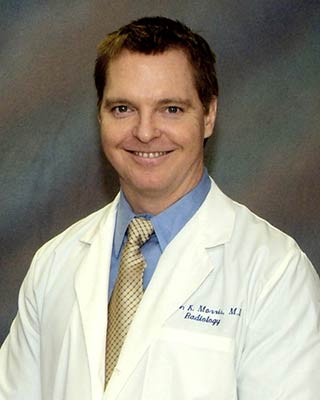
Providers